
When a Student Doesn’t Trust the Count
Have you ever worked with a student who still uses their fingers for almost every addition problem, even when the numbers go beyond 10?
The problem isn’t simply that they don’t know their addition facts. They just don’t yet trust the count.
For some students, it goes even further. We’ve worked with students who will hold up one hand and count their fingers just to check there are still five before they begin adding.
When we see this, it tells us something important. The difficulty isn’t necessarily that the student hasn’t been taught addition facts. They may not yet have developed enough confidence in quantity to trust what they already know.
Learning to Trust What They See
This is one of the reasons we developed Trust the Count: Making 10, drawing on the research and teaching approaches of Ronit Bird.
The activities use structured dot patterns, hands-on materials and repeated visual experiences to help students recognise quantities without needing to begin counting again from one. The aim isn’t simply to make students faster. It is to help them develop confidence in what they can already see and know.
As quantities become familiar, students can begin to recognise them as complete amounts rather than collections of individual objects that need to be counted every time.
What Can This Look Like in Practice?
We’ve been using Trust the Count with a student who relied heavily on counting. At the beginning, even familiar quantities weren’t always trusted without checking them first.
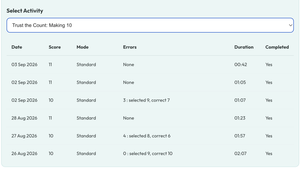
On 26 August, the student completed the activity in 2 minutes 7 seconds, scoring 10/11 with an error. By 3 September, the same student completed it in just 42 seconds, scoring 11/11 with no errors.
The Time Isn’t the Most Important Part
The improvement in speed is impressive, but the stopwatch isn’t actually the part we’re most interested in.
What we’ve watched change is the way this student sees and trusts quantities. Dot-card patterns that previously needed to be checked by counting are becoming familiar quantities that can be recognised and trusted.
That distinction matters. We don’t want a student to become exceptionally fast at counting everything from one. We want to reduce the need to count from one in the first place.
For a student who has spent years counting everything, sometimes the goal isn’t to teach them to count faster. It’s to help them realise they don’t need to count it again.
This gives us a visual learning pathway.
Trust the Count
Recognise familiar quantities and develop confidence in structured dot patterns without repeatedly counting from one.
Dot Card Addition
Use familiar visual quantities to begin combining numbers and practising addition without immediately returning to counting everything individually.
Maths Fluency
Move towards increasingly efficient recall and practise addition, subtraction, multiplication and division facts as number knowledge becomes more secure.
Leave a Reply